TKR Recovery Timeline Estimator
Enter your details to see a personalized roadmap for returning to normal walking.
Your Estimated Recovery Status
Personalized Milestones
Please enter your surgery date and details to view your personalized recovery timeline.
You’ve just had your Total Knee Replacement (TKR). The pain that kept you awake for years is finally gone, replaced by the throbbing awareness of a new joint. You’re eager to get back to life-to walk your dog, visit the market, or just cross the room without grabbing onto walls. But how long until you can actually walk normally? Is it two weeks? Two months? Six months?
The honest answer isn’t a single date. It’s a curve. Most patients see significant improvement in their gait within 6 to 12 weeks, but "normal"-meaning no limp, full stride length, and endurance for daily tasks-often takes 3 to 6 months. If you are reading this from Pune or anywhere else in India, where humidity and heat might affect swelling, or if you have specific lifestyle demands like climbing stairs frequently, your timeline might shift slightly. This guide breaks down exactly what happens week by week, why some people walk sooner than others, and how to speed up your progress without risking your new knee.
The Short Answer: A Realistic Timeline
If you want the quick numbers before diving into the details, here is what the data shows for an uncomplicated primary total knee arthroplasty:
- Days 0-3: Walking with a walker or crutches. Distance: 10-50 meters.
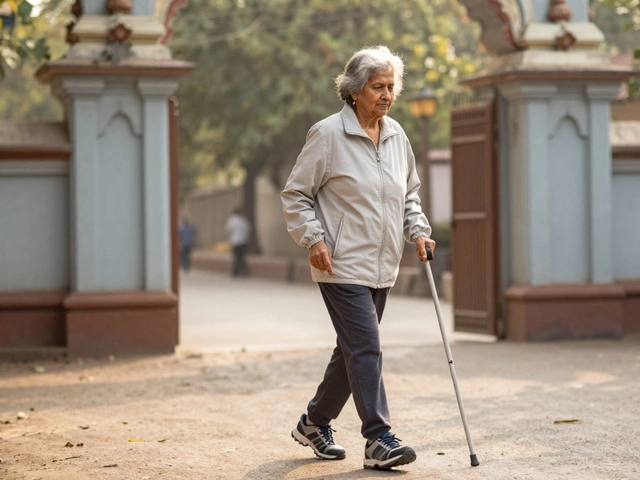
- Weeks 2-4: Transitioning to a cane or no aid (if stable). Distance: Up to 100-200 meters.
- Weeks 6-8: Walking without aids indoors. Stair climbing improves significantly.
- Months 3-6: Normal gait pattern emerges. Outdoor walks of 1-2 km become comfortable.
- Year 1: Full functional recovery. High-impact activities may still be restricted.
Notice that "walking normally" usually aligns with the 3-month mark. By then, your quadriceps muscles-the big muscles on the front of your thigh-have regained enough strength to stabilize the knee during the swing phase of walking. Before that, you are mechanically compensating, which often looks like a limp.
Why Your First Steps Feel So Weird
When you take your first steps post-surgery, your brain is confused. For years, your body learned to protect the damaged knee. Now, the hardware is new, but the software (your nervous system) hasn’t updated yet. This phenomenon is called Muscle Inhibition. Specifically, your quadriceps muscle shuts down temporarily due to surgical trauma and swelling.
You might feel like your leg is "dead weight." You try to lift it, but it feels heavy. This isn’t nerve damage; it’s neural suppression. Your body is literally preventing the muscle from firing fully to protect the joint. Overcoming this requires active effort, not just passive rest. This is why physical therapy starts immediately, often on the same day as surgery.
| Time Post-Surgery | Walking Aid | Gait Quality | Typical Distance |
|---|---|---|---|
| Day 1-3 | Walker/Crutches | Hesitant, short steps | 50 meters |
| Week 2 | Cane/Walker | Slight limp, slow pace | 100 meters |
| Week 6 | Cane or None | Improved symmetry | 300-500 meters |
| Month 3 | None | Near-normal cadence | 1 kilometer |
| Month 6+ | None | Normal gait | Unlimited (daily use) |
The Critical Role of Quadriceps Strength
You cannot walk normally if you cannot straighten your leg fully while standing. This is known as the Terminal Knee Extension. If you lack 5 degrees of extension, your knee will buckle slightly when you put weight on it. To compensate, you’ll hike your hip or lean your torso, creating a limp.
Most patients underestimate how much strength they lose during the first two weeks. Studies suggest up to 30% quadriceps atrophy occurs in the first month if you aren’t doing specific exercises. Here is what you need to focus on:
- Straight Leg Raises: These fire the quad without bending the knee. Do them daily.
- Quad Sets: Tightening the thigh muscle against a rolled towel under the knee.
- Heel Slides: Improves flexibility so you can bend the knee properly during the swing phase of walking.
If you skip these because they hurt, you delay your return to normal walking. Pain management is part of the process, not a reason to stop moving.

Factors That Slow Down Your Progress
Not everyone recovers at the same speed. If you find yourself stuck at the "cane stage" for more than 6 weeks, one of these factors is likely at play:
Pre-operative Health: If you were sedentary before surgery, your baseline muscle mass was lower. Building strength from zero takes longer. Patients who pre-habilitated (exercised before surgery) typically walk unaided 2 weeks faster.
BMI and Weight: Every extra kilogram adds 3-4 kg of force on your new knee with every step. Higher BMI correlates with slower gait normalization. Losing even 5% of body weight post-op can dramatically improve walking efficiency.
Fear-Avoidance Behavior: This is psychological. Many patients are afraid of dislocating the implant or causing pain, so they walk stiffly. This stiffness leads to muscle weakness, which leads to more instability, which reinforces the fear. Breaking this cycle requires confidence, often built through supervised physiotherapy sessions.
Complications: Issues like deep vein thrombosis (DVT), infection, or heterotopic ossification (bone growth in soft tissue) can halt progress. If you experience sudden calf pain, excessive redness, or fever, contact your surgeon immediately.
How to Speed Up Your Return to Normal Walking
You can’t rush biology, but you can optimize it. Here are practical, evidence-based strategies used by top orthopedic centers in India and globally:
1. Ice and Elevation are Non-Negotiable
Swelling blocks movement. If your knee is swollen, your quad won’t fire. Ice for 20 minutes every 2 hours during the first 2 weeks. Elevate your leg above heart level when resting. This reduces fluid accumulation, allowing better range of motion.
2. Walk Frequently, Not Far
In the early stages, quality beats quantity. Five short walks of 5 minutes each are better than one exhausting 25-minute walk. Fatigue leads to poor form. Poor form leads to bad habits that are hard to break later.
3. Use the Right Footwear
Wearing flip-flops or loose slippers increases the risk of tripping and alters your gait mechanics. Wear supportive sneakers with good grip. This provides stability and encourages a heel-to-toe rolling motion, which is essential for normal walking.
4. Engage Core Muscles
Walking isn’t just about legs. Your core stabilizes your pelvis. Weak abs mean your hips drop side-to-side (Trendelenburg gait). Incorporate gentle core exercises like pelvic tilts into your routine.

When to Worry About Your Gait
Some limping is normal. However, certain patterns indicate you need professional help:
- Antalgic Gait: Spending too little time on the operated leg due to pain. If this persists past 6 weeks, check your pain management plan.
- Quadriceps Avoidance: Bending the knee excessively while walking to avoid locking out. This means your quad is still inhibited.
- Stiff-Legged Gait: Swinging the whole leg around because you can’t bend the knee enough. This suggests limited flexion range.
If you notice these patterns, ask your physiotherapist to assess your gait. They might use video analysis or pressure mats to give you objective feedback.
Living with Your New Knee: The Long Game
By the 6-month mark, most patients report that they forget they have an artificial knee. You can go to temple visits, walk in parks, and manage household chores without thinking about it. The key is consistency. Recovery isn’t linear; there will be good days and bad days. Some weeks, your knee might ache after rain-a common complaint in humid climates like Pune. This doesn’t mean failure; it’s just weather sensitivity.
Remember, the goal isn’t just to walk. It’s to walk efficiently. Efficient walking saves energy, reduces fatigue, and protects your other joints (hips and ankles) from overuse injuries. Prioritize form over speed. Once your form is solid, speed will follow naturally.
Can I drive a car after total knee replacement?
Yes, but timing depends on which knee was operated on. If it’s your right knee (driving knee), wait until you can perform an emergency stop safely, usually 4-6 weeks. If it’s the left knee and you drive an automatic transmission, you might drive sooner, around 2-3 weeks. Always consult your surgeon first.
Why does my knee click when I walk?
Clicking or popping sounds are very common after TKR. It’s usually caused by soft tissues rubbing over the metal components or gas bubbles in the joint fluid. Unless accompanied by pain or swelling, it is generally harmless and tends to diminish as scar tissue matures over 6-12 months.
Is it safe to climb stairs immediately after surgery?
Yes, but technique matters. Remember the rule: "Up with the good, down with the bad." Lead with your non-operated leg going up, and lead with your operated leg going down. Use the handrail for support. Most patients can navigate stairs independently by week 4.
How long should I use a cane?
Most patients transition from a walker to a cane between weeks 2 and 4, and drop the cane entirely between weeks 6 and 8. Keep using it until you can walk 100 meters without limping. Using it too long can weaken your muscles; dropping it too soon risks falls.
Will I ever be able to run again?
High-impact running is generally discouraged after TKR to preserve the implant lifespan. However, brisk walking, cycling, and swimming are highly recommended. Some patients do resume light jogging, but this should only happen after clearing with your orthopedic surgeon, typically after 6-12 months.