Cancer Survival Rate Calculator
Enter Cancer Details
How This Works
This calculator estimates 5-year survival rates based on medical data from the article. Remember that survival rates are statistical averages and individual outcomes may vary significantly.
What does "cured" mean?
In medicine, "cured" means no signs of cancer for five years or more after treatment. Most recurrences happen within this window.
When someone hears the word cancer, their mind often goes to one question: Can it be cured completely? The answer isn’t simple. It’s not a yes or no. It depends on the type, stage, genetics, and how early it’s caught. Some cancers can be eliminated for good. Others become manageable diseases-like diabetes or high blood pressure-where you live with it, not because of it. There’s no single cure for cancer because cancer isn’t one disease. It’s hundreds.
What does "cured" actually mean?
In medicine, "cured" doesn’t mean "never comes back." It means no signs of cancer for five years or more after treatment. Doctors use this five-year mark because most cancers that are going to come back do so within that window. If someone stays cancer-free past five years, the chance of recurrence drops sharply. For some types-like testicular cancer or early-stage melanoma-it’s as low as 1%.
But here’s the catch: being in remission doesn’t always mean the cancer is gone forever. Tiny clusters of cells can hide in the body, sleeping for years. That’s why some people develop cancer again 10, 15, even 20 years later. It’s rare, but it happens. So when doctors say "cured," they mean "extremely unlikely to return," not "impossible to return."
Which cancers can be cured completely?
Some cancers have cure rates above 90% when caught early. These include:
- Testicular cancer - Over 95% survival rate at stage I. Even stage III has a 70%+ survival rate.
- Thyroid cancer - Nearly 98% five-year survival for localized cases.
- Early-stage melanoma - 99% survival when caught before spreading.
- Hodgkin lymphoma - 85-90% cure rate even in advanced stages.
- Childhood acute lymphoblastic leukemia (ALL) - Over 90% cure rate in kids under 15.
These cancers respond well to surgery, radiation, or chemotherapy because they’re either slow-growing, highly visible, or sensitive to treatment. They don’t mutate as wildly as others. That’s why they’re curable.
But not all cancers are like this. Pancreatic cancer, glioblastoma, and advanced lung cancer still have five-year survival rates under 10%. Why? They’re often found late, spread quickly, and resist treatment. Even when they shrink with drugs, they come back stronger.
Why can’t all cancers be cured?
Cancer isn’t a single invader. It’s your own cells going rogue. Every cancer has a unique genetic fingerprint. Two people with "lung cancer" might have tumors driven by completely different mutations. That’s why one person responds to a drug while another doesn’t.
Also, cancer evolves. Treatments kill the easy-to-kill cells. The survivors? They’re the ones with mutations that let them hide, adapt, or grow faster. These cells become the next generation of cancer. It’s evolution in fast-forward.
And then there’s the body. Your immune system is supposed to hunt down abnormal cells. But cancer learns to trick it. It puts up "don’t eat me" signs. It hides in places like bone marrow or the brain, where drugs can’t reach easily. Some tumors even build protective shields of scar tissue around themselves.
That’s why single treatments rarely work anymore. Modern oncology uses combinations: surgery to remove the main tumor, radiation to zap leftover cells, chemo to hit circulating cancer, immunotherapy to wake up the immune system, and targeted drugs to attack specific mutations.
What’s changing the game now?
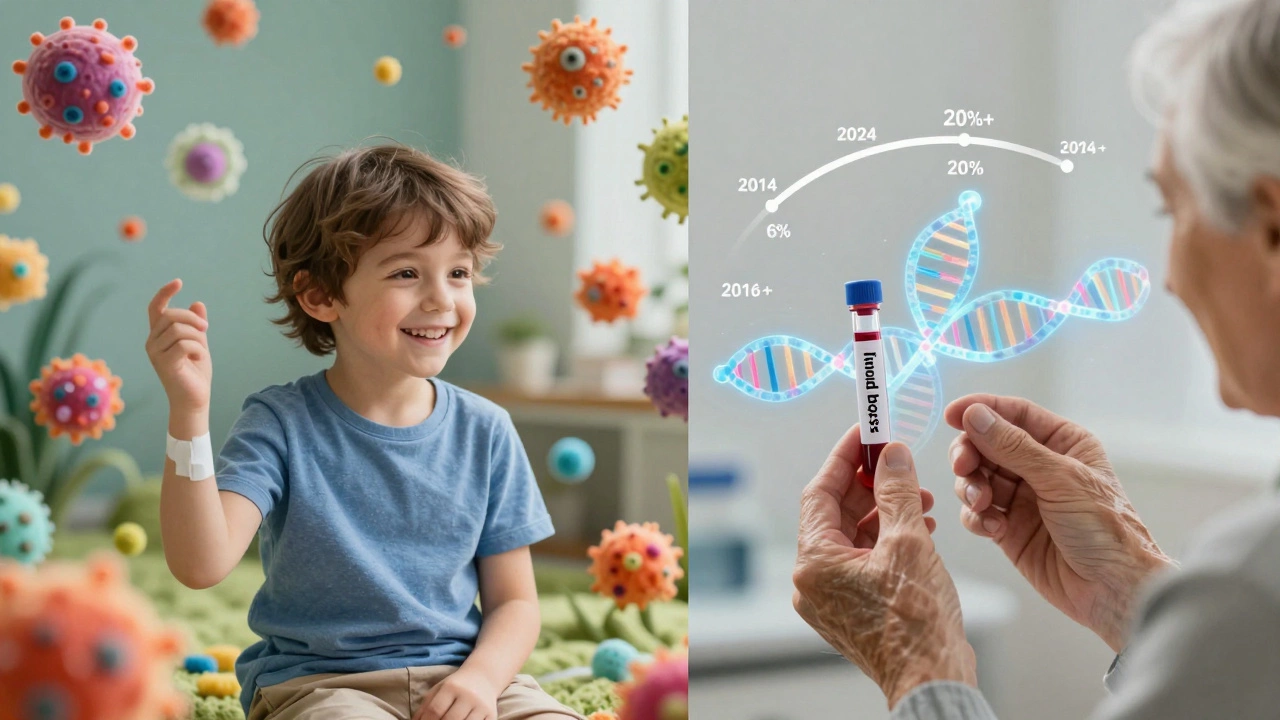
Five years ago, a patient with stage IV lung cancer had a 6% chance of surviving five years. Today, that number is over 20%. Why? Because of two breakthroughs:
- Targeted therapies - Drugs like osimertinib (Tagrisso) lock onto specific mutations in EGFR genes. They don’t just shrink tumors-they can keep them from growing for years.
- Immunotherapy - Drugs like pembrolizumab (Keytruda) remove the brakes on T-cells. These immune cells then recognize and kill cancer cells. Some patients with advanced melanoma or lung cancer have stayed in remission for over a decade.
There’s also liquid biopsies now. Instead of cutting into tumors, doctors can draw blood and find cancer DNA floating in the stream. This lets them monitor treatment in real time. If the cancer starts to change, they switch drugs before it grows back.
And gene editing? CRISPR is still experimental, but early trials are showing promise in turning off cancer-causing genes or reprogramming immune cells to hunt cancer like a missile.
What about early detection?
One of the biggest reasons cancer is deadly is because it’s found too late. That’s why screening saves lives.
Colonoscopies cut colon cancer deaths by 60%. Mammograms reduce breast cancer mortality by 20-40%. Low-dose CT scans for heavy smokers cut lung cancer deaths by 20%. But screening isn’t perfect. It can miss cancers. Or find things that will never harm you-leading to unnecessary surgery.
That’s why new tests are coming. A blood test called Galleri can detect over 50 types of cancer from one draw. It’s not in every clinic yet, but in 2026, it’s being tested in large public health programs across India and the U.S. If it works, we could catch cancers before symptoms appear.
Can lifestyle prevent cancer?
Yes-but not completely. About 30-50% of cancers are linked to preventable causes: smoking, alcohol, obesity, poor diet, lack of exercise, UV exposure, and infections like HPV or hepatitis.
For example, quitting smoking cuts lung cancer risk by half after 10 years. HPV vaccines prevent 90% of cervical cancers. Losing 5-10% of body weight reduces risk of liver, kidney, and breast cancer.
But genetics matter too. Some people inherit faulty genes like BRCA1 or Lynch syndrome. They’ll get cancer even if they eat kale, run marathons, and never smoke. That’s why prevention isn’t a cure. It’s damage control.
What’s the future?
By 2030, doctors expect to classify cancers not by where they start (lung, breast, colon), but by their genetic signature. A tumor in the liver might be treated the same as one in the lung if they share the same mutation.
Personalized vaccines are being tested. Imagine a vaccine made from your own tumor’s DNA. It trains your immune system to recognize and destroy cancer cells before they spread.
AI is helping too. Machine learning models now predict which drugs will work for which patients with 85% accuracy-far better than guesswork.
Will we ever have a single cure? Probably not. But we’re moving toward a future where cancer is no longer a death sentence. For many, it’s becoming a chronic condition-something you manage, not fear.
What should you do now?
If you’re healthy: get screened. Know your family history. Don’t ignore symptoms like unexplained weight loss, persistent pain, or unusual bleeding. Early detection saves lives.
If you’re diagnosed: ask about molecular testing. Not all hospitals offer it yet, but it’s becoming standard. Find out what mutations drive your cancer. Ask if targeted therapy or immunotherapy is an option. Don’t assume one treatment fits all.
If you’re a caregiver: support, not pressure. Cancer isn’t won by willpower alone. It’s won by science, timing, and access to the right care.
The truth? Some cancers can be cured. Others can’t-but they can be controlled for years. And the gap between those two is shrinking every year.
Can cancer be cured in its final stage?
In most cases, stage IV cancer-where it has spread to distant organs-is not considered curable. But that doesn’t mean hopeless. Treatments like immunotherapy and targeted drugs can shrink tumors, extend life by years, and improve quality of life. Some patients with metastatic melanoma or lung cancer have lived over a decade with the disease under control. The goal shifts from cure to long-term management.
Why do some cancers come back after being "cured"?
Cancer cells can hide in tiny numbers during treatment. These cells may be dormant, resistant to drugs, or protected by the body’s tissues. Years later, changes in the body’s environment-like hormonal shifts or immune system decline-can wake them up. That’s why follow-up scans and blood tests are critical, even after five years.
Is immunotherapy a cure for cancer?
Immunotherapy isn’t a cure for everyone, but it’s changed outcomes for some. In about 15-30% of patients with advanced melanoma or non-small cell lung cancer, it leads to long-term remission-sometimes lasting decades. It works best when the tumor has many mutations (which makes it more visible to the immune system). It doesn’t help all cancers, and it can cause serious side effects. But for those who respond, it’s often the closest thing to a cure we have.
Do natural remedies cure cancer?
There is no scientific evidence that herbs, supplements, or alternative therapies can cure cancer. Some, like turmeric or green tea, may help reduce inflammation or support general health. But relying on them instead of proven treatments can be deadly. Many patients who delay conventional care for alternative therapies have worse outcomes. Always talk to your oncologist before trying anything outside standard care.
Can children be cured of cancer more easily than adults?
Yes. Children’s cancers often respond better to chemotherapy and radiation because their cells divide faster and are more sensitive to treatment. Also, pediatric cancers tend to have fewer mutations than adult cancers. For example, acute lymphoblastic leukemia (ALL) has a cure rate over 90% in kids but only 40-50% in adults. That’s why pediatric oncology has seen the biggest survival gains in the last 50 years.
Is cancer inherited?
About 5-10% of cancers are linked to inherited gene mutations. BRCA1 and BRCA2 increase breast and ovarian cancer risk. Lynch syndrome raises the risk of colon, uterine, and stomach cancers. If multiple close relatives had cancer at young ages, genetic testing may be recommended. But even with these genes, cancer isn’t guaranteed-just more likely. Prevention and early screening are key.
What’s the difference between remission and cure?
Remission means no detectable cancer after treatment. It can be partial (tumor shrinks) or complete (no signs left). A cure means cancer is gone and won’t come back. In practice, doctors use "cure" to describe someone who’s been in complete remission for five or more years. But technically, cancer can return even after that-so "cure" is a practical term, not a guarantee.
Science is moving faster than ever. What was impossible a decade ago is now routine. The goal isn’t just survival-it’s living well after cancer. And that future is closer than most people realize.