
Orthopedic Procedure Explorer
Select a surgical procedure below to learn about its purpose, decode the medical terminology, and see how it compares to other treatments.
Select a procedure
Click on an option from the list to view details.
Procedure Name
BadgeDescription goes here.
Terminology Decoder
Understanding the Latin/Greek roots:
Key Characteristics
- Primary Goal: Goal
- Typical Recovery: Recovery
- Best For: Patient type
Quick Comparison Chart
| Procedure | Primary Goal | Recovery Time | Ideal Candidate |
|---|
You have a broken leg, a worn-out knee, or severe back pain. The doctor says you need an operation on your skeleton. But what do you actually call that procedure? Is it just "bone surgery"? Or is there a more specific medical term you should know before you step into the hospital?
The short answer is orthopedic surgery. This is the broad umbrella term for any surgical procedure involving the musculoskeletal system-your bones, joints, ligaments, tendons, and muscles.
However, "orthopedic surgery" is like saying "car repair." It’s true, but it doesn’t tell you if they are changing the oil or replacing the engine. In medicine, we use much more specific names depending on exactly what part of the bone or joint is being fixed. Knowing these terms helps you understand your diagnosis, ask better questions, and feel less anxious about the unknown.
The Umbrella Term: Orthopedic Surgery
When people ask, "What is bone surgery called?" they are usually looking for this term. An orthopedic surgeon (or orthopedist) is the doctor who performs these operations. They don't just fix breaks; they handle everything from sports injuries in teenagers to degenerative arthritis in seniors.
Think of orthopedics as the mechanic for your body's framework. If your car frame is bent, the wheels won't turn right. Similarly, if your bones or joints are damaged, your mobility suffers. Orthopedic surgery aims to restore that movement and relieve pain.
Common Specific Names for Bone Surgeries
While "orthopedic surgery" is the category, the actual procedure has a specific name based on the action taken. Here are the most common types you will encounter in an orthopedic hospital setting.
1. Osteotomy: Cutting and Realigning
If your bone is deformed or angled incorrectly, a surgeon might perform an Osteotomy is a surgical procedure where a bone is cut and realigned to correct deformity or improve weight distribution.
This is often done for knees affected by early-stage arthritis. Instead of replacing the whole joint, the surgeon cuts the tibia (shin bone) to shift your weight away from the damaged part of the knee. It’s like leveling a wobbly table by trimming one of the legs.
2. Arthroplasty: Joint Replacement
When a joint is too damaged to save, surgeons perform Arthroplasty is the surgical reconstruction or replacement of a joint using prosthetic implants. You’ve probably heard this called a "joint replacement."
- Total Knee Arthroplasty: Replacing both the femur and tibia surfaces with metal and plastic components.
- Total Hip Arthroplasty: Replacing the ball and socket of the hip joint.
- Hemiarthroplasty: Replacing only one part of the joint, often used in hip fractures for elderly patients.
This is one of the most successful surgeries in modern medicine. Millions of people walk out of hospitals with new hips or knees that function nearly normally within weeks.
3. Osteosynthesis: Fixing Fractures
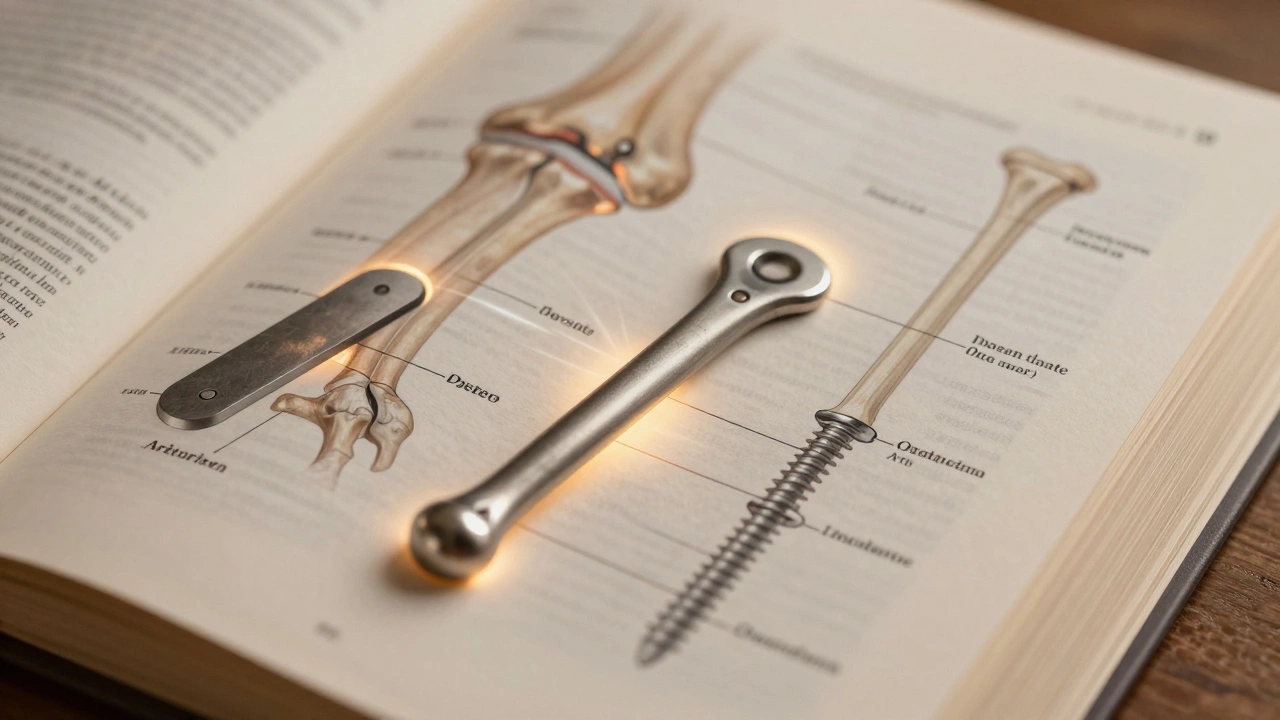
If you break a bone badly enough that a cast won't work, you need Osteosynthesis is the surgical fixation of bone fragments using hardware such as plates, screws, rods, or wires.
This isn't just gluing the bone back together. Surgeons use titanium plates and screws to hold the bone pieces in perfect alignment while they heal. For long bones like the femur, they might insert a metal rod down the center of the bone (intramedullary nailing). This allows you to move sooner, which prevents complications like blood clots or muscle atrophy.
4. Spinal Fusion: Stabilizing the Back
Back pain is a huge reason people visit orthopedic specialists. When vertebrae are unstable due to injury, scoliosis, or degeneration, surgeons may perform a Spinal Fusion is a procedure that joins two or more vertebrae together permanently using bone grafts and hardware.
The goal here is to stop painful motion between the bones. They place bone graft material between the vertebrae and secure it with screws and rods. Over time, the bones grow together into a single solid piece. It’s a major surgery, but it can be life-changing for those with chronic instability.
5. Debridement: Cleaning Up Damage
Sometimes, the surgery isn't about building something new, but removing what’s bad. Debridement is the removal of dead, damaged, or infected tissue to improve the healing potential of the remaining healthy tissue.
In open fractures or severe infections (osteomyelitis), surgeons must clean out the bone and surrounding soft tissue. This is often the first step before any reconstruction can happen. Without proper debridement, implants can get infected, leading to serious complications.
Why Do Doctors Use Latin-Based Names?
You might wonder why doctors say "arthroplasty" instead of "joint fix." Medical terminology comes largely from Greek and Latin roots. This provides precision.
- Osteo- means bone.
- Arthro- means joint.
- -Plasty means molding or reconstructing.
- -Tomy means cutting.
- -Synthesis means putting together.
Knowing these roots helps you decode what your doctor is telling you. If you hear "osteochondritis," you know it involves bone (osteo) and cartilage (chondro) inflammation (itis). It turns scary jargon into understandable concepts.
How to Choose the Right Procedure
Not every bone problem needs surgery. In fact, most minor fractures and strains heal with rest, physical therapy, and medication. Surgery is usually reserved for cases where:
- Pain is unmanageable: Daily life is severely impacted despite conservative treatments.
- Function is lost: You cannot walk, lift, or move without significant limitation.
- Structural damage is severe: Bones are displaced, joints are destroyed, or nerves are compressed.
Your orthopedic surgeon will review X-rays, MRIs, or CT scans to determine the best approach. They might suggest a minimally invasive arthroscopy (using small cameras and tools) rather than open surgery if possible. Minimally invasive techniques lead to faster recovery times and smaller scars.
| Procedure Name | Primary Goal | Typical Recovery Time | Best For |
|---|---|---|---|
| Osteotomy | Realign bone to shift weight | 3-6 months | Early arthritis, young active patients |
| Arthroplasty | Replace damaged joint surfaces | 6-12 weeks for basic function | Severe osteoarthritis, elderly patients |
| Osteosynthesis | Fix broken bone fragments | 6-8 weeks for bone union | Complex fractures, displaced breaks |
| Spinal Fusion | Stabilize vertebrae | 3-6 months for fusion | Scoliosis, herniated discs, instability |
| Debridement | Remove infected/dead tissue | Varies widely | Infections, open wounds, necrosis |
Recovery and Rehabilitation
Surgery is only half the battle. The other half is rehabilitation. Whether you had a simple fracture repair or a total hip replacement, you will need physical therapy.
Muscles weaken quickly when you aren't moving. Physical therapists guide you through exercises to regain strength, flexibility, and balance. Skipping rehab is the number one reason patients don't achieve full results after bone surgery.
Recovery timelines vary. A wrist fracture might heal in six weeks. A spinal fusion can take up to a year for the bones to fully fuse. Your surgeon will give you a personalized timeline, but patience is key. Pushing too hard too soon can undo the surgical work.

Risks and Considerations
All surgeries carry risks. For bone surgeries, common concerns include:
- Infection: Especially dangerous if implants are involved. Signs include fever, redness, and drainage.
- Blood Clots: Deep vein thrombosis (DVT) is a risk after lower limb surgeries. Blood thinners and early movement help prevent this.
- Nerve Damage: Temporary numbness or tingling can occur near the surgical site.
- Implant Failure: While rare, screws or plates can loosen or break over time, especially in high-impact activities.
Discuss these risks openly with your surgeon. Ask about their experience with the specific procedure. Experience matters. A surgeon who performs 100 knee replacements a year will likely have smoother outcomes than one who does 10.
Living with Bone Health
Prevention is always better than cure. Keeping your bones strong reduces the likelihood of needing surgery later in life. Focus on:
- Calcium and Vitamin D: Essential for bone density. Get sunlight or supplements if needed.
- Weight-Bearing Exercise: Walking, jogging, and strength training stimulate bone growth.
- Fall Prevention: As we age, falls become a major cause of fractures. Improve home safety and balance.
If you already have bone issues, listen to your body. Pain is a signal. Ignoring it can turn a manageable condition into a surgical emergency.
What is the difference between orthopedic surgery and neurosurgery for spine issues?
Both orthopedic surgeons and neurosurgeons treat spine problems. Orthopedic surgeons focus on the bony structure, alignment, and stability of the spine. Neurosurgeons specialize in the nervous system, including the spinal cord and nerves. For conditions like scoliosis or degenerative disc disease, either specialist might operate, often working together in complex cases.
How long does a bone graft take to heal?
Bone graft healing varies by location and patient health. Generally, it takes 3 to 6 months for the graft to integrate with your natural bone. Smaller grafts in areas with good blood supply, like the jaw, may heal faster. Larger spinal fusions can take up to a year to fully consolidate.
Can bone surgery be reversed?
Some procedures, like removing screws after a fracture heals, are reversible. However, major reconstructions like joint replacements or spinal fusions are permanent. Revision surgery is possible if an implant fails, but it is more complex and carries higher risks than the initial operation.
Is robotic-assisted bone surgery safer?
Robotic assistance offers greater precision in placing implants and cutting bone, which can reduce soft tissue damage and improve alignment. Studies show slightly faster recovery times and fewer revisions for hip and knee replacements. However, the robot does not replace the surgeon's skill; it enhances accuracy.
What insurance covers bone surgery?
Most comprehensive health insurance plans cover medically necessary orthopedic surgeries. Elective cosmetic bone surgeries are rarely covered. Always check your policy's details regarding pre-authorization, co-pays, and network providers. Hospitals often have financial counselors to help navigate coverage options.