Cancer Survival Calculator
How Long Can You Live With Cancer?
Based on U.S. SEER data. Individual outcomes vary significantly based on treatment options, personal health, and other factors.
When someone hears the word cancer, their mind often jumps to one question: How long do I have? It’s a natural fear. But the truth is, there’s no single answer. Some people live for years with cancer. Others face a much shorter timeline. The difference? It’s not magic. It’s science - and it’s personal.
It Depends on the Type of Cancer
Not all cancers are the same. A diagnosis of thyroid cancer, for example, often comes with a 98% five-year survival rate. That means 98 out of 100 people are still alive five years after diagnosis. Many live much longer - sometimes decades. On the other hand, pancreatic cancer has a five-year survival rate of just 12%. That’s not a death sentence, but it does mean the odds are harder.
Here’s what real data shows for common cancers in adults:
| Cancer Type | Five-Year Survival Rate | Key Factors |
|---|---|---|
| Thyroid | 98% | Early detection, slow growth |
| Prostate | 97% | Often slow-growing, treatable |
| Breast (localized) | 99% | Screening, targeted therapies |
| Colorectal | 65% | Stage at diagnosis matters most |
| Lung (all stages) | 23% | Smoking history, subtype |
| Pancreatic | 12% | Often diagnosed late |
| Leukemia (ALL) | 70% (children), 30% (adults) | Age and genetics critical |
These numbers come from the U.S. Surveillance, Epidemiology, and End Results (SEER) program, which tracks cancer outcomes across 135 million people. They’re not predictions - they’re averages. Your situation may be very different.
Stage Matters More Than You Think
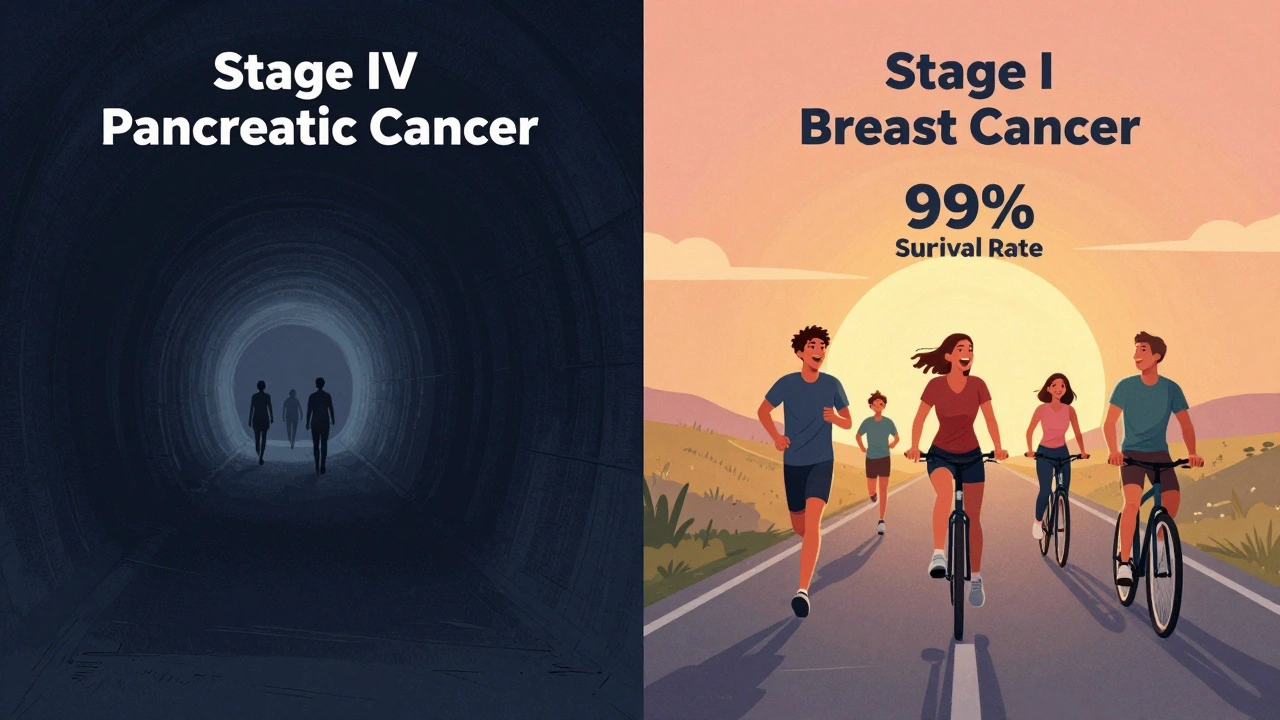
Two people with the same cancer type can have completely different outcomes - simply because one was caught early. Stage I cancer means the tumor is small and hasn’t spread. Stage IV means it’s moved to distant organs. The difference in survival can be huge.
Take breast cancer. At Stage I, survival is nearly 100%. At Stage IV, it drops to about 28%. That’s not a number you can ignore. That’s why screening matters. A mammogram, a colonoscopy, a skin check - these aren’t just checklists. They’re life extenders.
And here’s something most people don’t realize: Some cancers don’t even need treatment to be survivable. Prostate cancer in older men often grows so slowly that doctors recommend "watchful waiting" instead of surgery or chemo. The risk of treatment side effects can be higher than the cancer itself.
Treatment Can Change the Game
Five years ago, a diagnosis of metastatic melanoma meant a life expectancy of less than a year. Today? With immunotherapy drugs like pembrolizumab, over 50% of patients live five years or more. Some live ten. A few are functionally cured.
Same with lung cancer. Ten years ago, chemo was the only option. Now, targeted therapies and checkpoint inhibitors have changed survival for patients with EGFR or ALK mutations. These treatments don’t work for everyone - but for those they do, they can turn cancer into a chronic condition, like diabetes or high blood pressure.
And it’s not just drugs. Radiation techniques have gotten smarter. Surgery is more precise. Supportive care - managing pain, nausea, fatigue - has improved dramatically. All of this adds up to more time, more quality, more hope.
Age, Health, and Lifestyle Play a Role
Two 60-year-olds with the same cancer diagnosis can have very different outcomes. Why? One is fit, eats well, and doesn’t smoke. The other has diabetes, is overweight, and hasn’t exercised in years.
Studies show that people who maintain a healthy weight, stay physically active, and avoid tobacco and heavy alcohol use have better survival rates across nearly all cancer types. It’s not about being perfect. It’s about being better than before.
Even small changes matter. Walking 30 minutes a day can reduce the risk of cancer recurrence by 20-30% in breast and colon cancer survivors. Eating more vegetables and less processed meat helps. Sleeping well reduces inflammation. These aren’t "nice to haves." They’re part of treatment.
What About Advanced or Late-Stage Cancer?
When cancer spreads, the goal shifts. It’s no longer about cure. It’s about control. About comfort. About time.
Some people with stage IV cancer live for years. Others live for months. It depends on:
- How fast the cancer grows
- Which organs are affected
- How well the body responds to treatment
- Whether new therapies become available
For example, someone with stage IV breast cancer that’s hormone-sensitive may live 5-10 years or more with hormone therapy and targeted drugs. Someone with stage IV lung cancer that’s aggressive and has spread to the brain may have 6-18 months. But again - these are averages. Some live longer. Some live shorter. No one knows for sure.
That’s why doctors avoid giving exact timelines. They can’t. They don’t want to take away hope. They also don’t want to give false hope. So they talk in ranges: "months," "years," "possibly longer."

Survival Isn’t Just About Time
Living with cancer isn’t just about how long. It’s about how well.
A person who lives three years with cancer but is pain-free, works part-time, travels, and spends time with family has lived better than someone who lived five years in constant pain, isolated, and dependent on machines.
Palliative care - which focuses on quality of life, not curing - has been shown to actually extend life in some cases. A 2010 study in the New England Journal of Medicine found that lung cancer patients who got early palliative care lived longer than those who didn’t. They also had less depression and better symptom control.
That’s the real secret: treating the whole person, not just the tumor.
Hope Isn’t a Lie
People often think that if you’re not cured, you’re out of options. That’s wrong. Even in advanced cancer, there are treatments that slow growth, shrink tumors, and ease symptoms. New drugs are approved every year. Clinical trials are always looking for volunteers. Many of these trials offer access to treatments not yet available to the public.
And sometimes, the body surprises everyone. There are documented cases of people with stage IV cancer who went into complete remission - with no clear explanation. Science doesn’t have all the answers yet. And that’s why hope isn’t naive. It’s necessary.
What Can You Do Right Now?
If you or someone you love has cancer:
- Ask for the exact type and stage. Don’t settle for "it’s bad." Get the details.
- Find out what treatments are available - and what they can realistically do.
- Ask about clinical trials. They’re not just for last-resort cases.
- Get support: nutritionists, physical therapists, counselors. These are part of cancer care now.
- Don’t ignore lifestyle. Eat, move, sleep. It’s not just advice - it’s medicine.
There’s no magic number. But there is power - in knowledge, in action, in community. You’re not just waiting for time to pass. You’re shaping it.
Can you live 10 years with cancer?
Yes, many people do. Survival rates for cancers like thyroid, prostate, and early-stage breast cancer are so high that 10-year survival is common. Even for some advanced cancers - like hormone-sensitive breast cancer or certain types of melanoma - 10-year survival is possible with modern treatments. It’s not guaranteed, but it’s far from rare.
Is stage 4 cancer always fatal?
No. Stage 4 means the cancer has spread, but it doesn’t mean it’s untreatable. Many people live for years with stage 4 cancer. Treatments like targeted therapy, immunotherapy, and hormone therapy can control the disease, reduce symptoms, and extend life. Some patients live longer than expected, even with advanced disease. The key is personalized treatment and ongoing care.
Does chemotherapy shorten or extend life?
It depends. For some cancers, chemo is the best tool we have to extend life - sometimes by years. For others, especially in late stages, it may only add a few months and come with harsh side effects. The decision isn’t about being brave or giving up. It’s about matching the treatment to the cancer type, stage, and the person’s overall health. Doctors use survival data and quality-of-life metrics to guide these choices.
Can lifestyle changes really affect cancer survival?
Yes, and the evidence is strong. Studies show that regular physical activity, a diet rich in vegetables and whole grains, maintaining a healthy weight, and avoiding alcohol and tobacco can reduce recurrence and improve survival rates - especially for breast, colon, and prostate cancers. These aren’t "bonus" habits. They’re part of the treatment plan. One study found that breast cancer survivors who walked 3-5 hours per week had a 40% lower risk of dying from cancer.
Why do survival rates vary so much by country?
Access to early screening, advanced treatments, and supportive care makes a big difference. Countries with universal healthcare and strong screening programs - like Canada, Australia, and many in Europe - often report higher survival rates than countries where diagnosis is delayed or treatment is unaffordable. In India, for example, survival rates for cervical and breast cancer are lower because many cases are detected at later stages. Early detection saves lives.
Living with cancer isn’t about waiting for the end. It’s about making every day count - with the right tools, the right care, and the right support. You have more power than you think.